Showing posts with label Farming. Show all posts

Monday, January 26, 2015

Lots of Fun! French Buns at Firestone Creek!


Firestone Creek now has French angora RABBITS!

I'm a creativity junkie. I love being creative. I've always had an interest in fiber arts, and a few months back, we were thinking about purchasing a couple of alpacas (and we might still do that). I've also always LOVED the angora rabbits--all of them. I'm two shoes in for anything "fluffy," most of the time. 

Instead of diving into a sea of alpacas, we decided to start small with a few French angoras, and we've been having so much fun with this fiber and all of the fluffy snuggles and kisses from these guys. We added 7 (2 males and 5 females) and lost one female within 2 days due to some illness, probably brought on by stress and bad nutrition from the previous owner. I treated everyone else with my herbal immune building formulation, began a new diet of high protein pellets, timothy, alfalfa, and crudities, and everyone else is fine and doing well. In fact, they are producing lots of fine hair and having babies! 


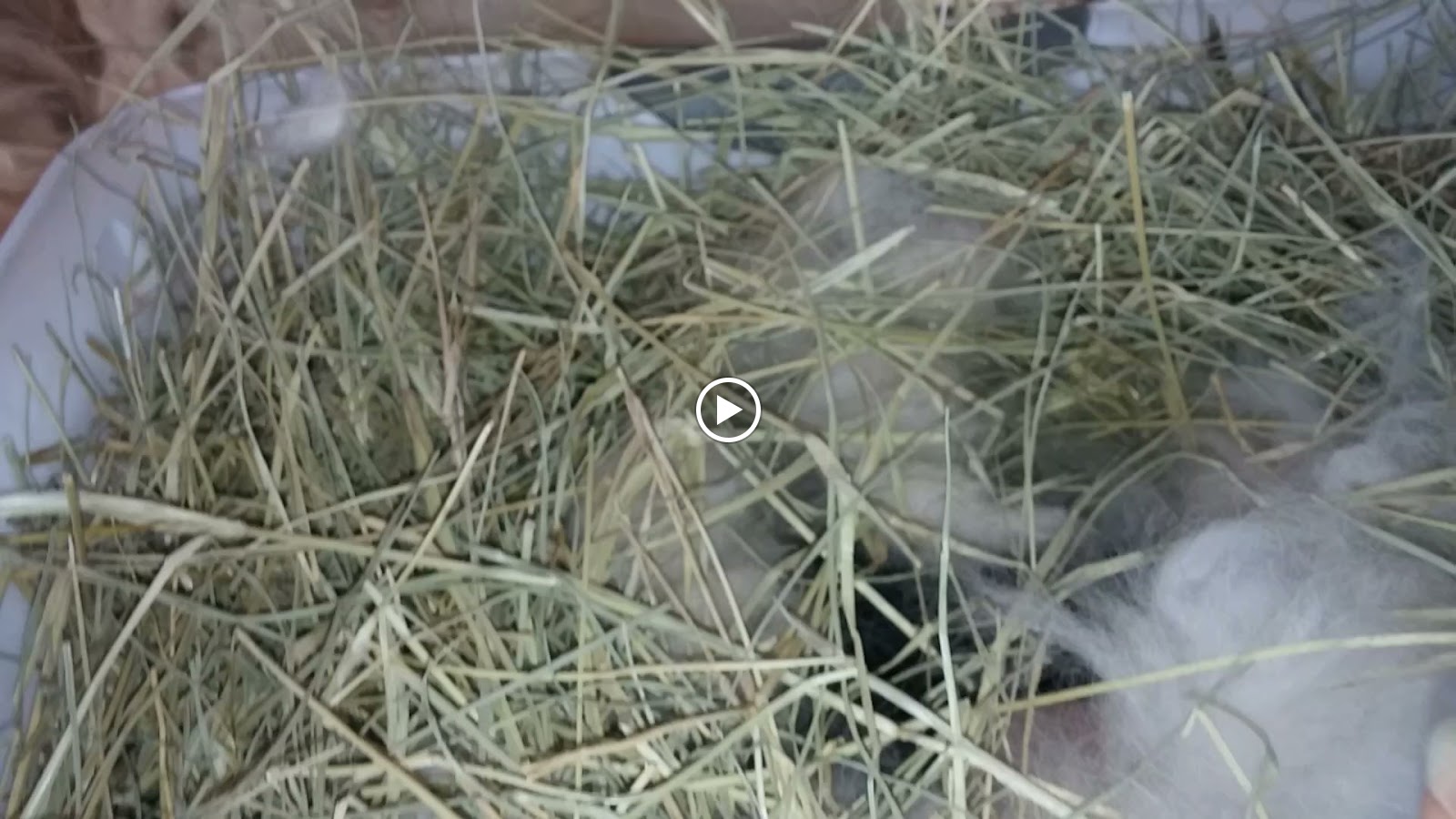
When we got these buns, they were matted and looking pretty rough. The lady actually admitted she had NEVER brushed them! I was in shock. As you can see in some of the photos, they do still have a few underbody mats, and two of the adults are moulting now, too. I've been working on the mats, but since it is winter, I don't want to begin shaving/clipping huge areas of hair away from their bodies, so I have to do it slowly--a little at a time. In the photo to the right, one of our males (Sebastian--middle) is visiting with two of the girls (one is hiding behind him). We also have a REW buck, but we bred Sebastian to everyone. So far, he was bred to our chocolate tort and produced two self blacks, two whites (not sure if they are BEW or REW because the eyes haven't opened yet), and one black tort (from what I can tell). He also bred our black tort and she delivered four little buns-- one that looks like it is a blue or lilac point, and the others are all blue/black torts.


It looks like we are going to have quite a few babies for sale, so we are now taking reservations. Currently, one of the self-blacks and most of the torts will be available for $45 each without papers. These will make wonderful little fiber fluffs to add some color to your fiber projects. The whites (whether blue eyed or red eyed) are also available as is the adult REW male we have. Since we are already getting REW out of our girls, we want to find him a good home. If interested, contact us via the farm site.


Friday, August 8, 2014

Panir -- Paneer -- Queso Fresco -- Whatever you want to call it!


Fresh Cheese

Panir, Paneer, Queso Frescho-- No Matter how you say it, it is Fresh Cheese and one of the easiest things you can make with fresh goat's milk. Many recipes will call for using lemon or vinegar for making fresh cheese, but I've found that using freshly made (or cultured) buttermilk and/or kefir works quite well and makes for a very flavorful cheese. Additionally, you can use fruit juices and even yogurt. Your goal is to raise the acidity of the milk after heating it. For fresh cheese, you heat to the boiling point but DO NOT BOIL. The best temp is around 195-200 F. 


Here's a simple recipe that can also be found on my website at Firestone Creek farm. If you have questions, feel free to ask me here in the comments or you can always add Firestone Creek Farm on Facebook and message me there.


Paneer


Ingredients:

  • 1 quart full-cream goat's milk 
  • buttermilk and/or Kefir (use what you have)
    • **1/2 cup buttermilk AND 1/2 cup kefir 
    • OR 3/4 cup buttermilk 
    • OR 3/4 cup kefir
    • *you may also use yogurt (1/2 buttermilk and 1/2 yogurt)
    • *you can use lemon juice or vinegar, but it tastes differently and the end result isn't as sweet
****When using buttermilk, I always get a much higher yield than when using lemon juice or vinegar.****

Preparation:

  • Pour the milk into a heavy pan that will not allow the milk to scorch while heating. Stir often.
  • As the milk is readied, measure the buttermilk and/or kefir.
    You can use store bought buttermilk, but I prefer to make my own. 

  • Watch the milk closely, stirring to keep it from sticking.
  • When the milk comes to a boil, add the buttermilk/kefir.
  • Reduce the heat and stir.The milk should change colors and begin to separate. Cheese curds will form, leaving a yellowish-greenish colored whey behind. 
  • Stir continuously until the milk is completely curdled.
  • Remove from the heat when the separation of the curds and yellowish whey is complete


  • Pour contents of pot into a strainer lined with clean muslin cloth

 
  • Wrap the muslin tightly, tie it, and squeeze out excess whey,
    holding it under cold water for approximately a minute to help rinse it clean. 
  • Hang the cheese for 15-20 minutes so that all the whey is drained out.
SAVE YOUR WHEY FOR THE CHICKENS: They love it.

  • To form a block or circle , sit it into a round cheese strainer and place it under something heavy.
  • After 20+ minutes, remove from muslin, lightly salt, and cut into chunks. 
You are now ready to use your fresh cheese!!! 

Variations: I make a few. I've made salsa cheese, garlic cheese, pineapple cheese, jalapeno cheese and more. Experiment and have fun! 


Saturday, February 15, 2014

Best Homestead Chicken, Blossom, and Veggie Quiche EVER!


Best Quiche EVER!

So I am a big quiche fan, and I have had lots of quiche over the years, but this quiche is absolutely the best quiche you will ever put into your mouth or serve to friends and family. I've never had a bad review with this--nothing but clean plates. It's loaded full of fresh goodies. One feature flavor here is the squash blossom, and that's a wonderful addition to so many dishes if you have the blossoms in your garden in the spring and summer, sometimes even into the fall. Feel free to substitute and experiment if you need to. You can add mushrooms if you like, but I haven't done so here. You can even change this to a vegetarian only dish if you like (omit the chicken). Simply prep, bake, and have some yum fun!

Ingredients (very important)--the fresher, the better!

2 tablespoons butter (fresh goat's milk butter would be great!)
3 chopped green onions (or 1 small minced onion)
1 teaspoon fresh minced garlic
1 cup fresh chopped broccoli
1/2 cup fresh chopped red/orange/yellow sweet peppers  
1/2 cup fresh, cleaned and chopped, squash and/or pumpkin blossoms
1 (9 inch) unbaked pie crust
3/4 cup fresh goat's milk mozzarella
3/4 cup cheddar (fresh if you have it!)
1/2 cup fresh panir (paneer) *See my blog or website if you need the recipe
4-7 farm fresh eggs (large eggs work well, so if they are small eggs, you will need more)
1/2 cup to 3/4 cup grilled chicken breast
1 1/2 cups fresh goat milk
1 tsp pink sea salt
1/2 tsp black pepper
1/2 tsp parsley
1 tablespoon melted butter

Directions

  1. Preheat oven to 350 degrees F (175 degrees C).
  2. Prepare all veggies by chopping, mincing, etc. For squash blossoms, remove stems and stamens. Wash petals well. Chop the petals. 


3. Next, over medium-low heat, melt butter in a large saucepan.Add onions, garlic, peppers, squash blossoms, broccoli, and paneer. Cook slowly, stirring occasionally until the vegetables are soft. 


4. When veggie and paneer mix is softened, toss in grilled chicken. It's best to pre-grill the chicken and then just warm it with the vegetables before adding it to the crust.
At this point, if you want a vegetarian dish, simply skip the chicken.
5. Prepare pie crust according to instructions on package. When crust is ready and vegetable mix is tender, spoon mix into the crust and sprinkle with cheeses and grilled chicken breast.


6. Combine eggs and milk into a mixing bowl. Season with salt, pepper, and parsley. Stir in melted butter. 

7. Pour egg mixture over the vegetable, chicken, and cheese blend.


8. Bake in preheated oven for 30-50 minutes (depends on your oven), or until center has set. Check the center with a fork to see when it has set.

Enjoy!

This quiche goes great with homemade goat's milk potato soup. That recipe coming soon! :) 

*Note: This recipe calls for goat milk products. If you do not have these, that is fine. You may substitute cow's milk or butter. You can make paneer with cow's milk, as well, but be sure the milk is not ultra pasteurized. See my website (http://www.freewebs.com/firestone-creek-farms ) for a paneer recipe.


Friday, February 14, 2014

Smelling Pink or Blue? Could it be True? The Sniff Chart! Join in on the fun!

Left to right: Acorn, Panama, Pistachio, Joy, Palabra, Palmella, Bella, and Palisade grazing and browsing in the new pasture.

Hi all! While we are on babywatch here at Firestone Creek (with six does due to kid between now and mid-March, and then just one more to go after that in late spring), I have decided to test a theory that some of us in the goat community were 'testing' a few years back. At the time, it seemed to hold mostly true, so I wanted to test it out again, for accuracy this time, while also recording my results. Join in if you like, and share your results.


Background

All dairy farmers want to 'see pink'; they want the majority of the kids born in a season to be does (female). Does can be retained to the herd, and since the main goal of most dairy farmers and homesteaders is to produce milk, more does means increased milk production. However, sometimes we have what we refer to as a 'buck year,' which simply means that the percentage of bucks born that season was much higher than that of the does born. Is that a bad thing? It certainly can be. For instance, if there is a large percentage of bucks born to a group of first fresheners (first time the doe has had babies), more than likely all of those will be wethered (castrated or not left intact as males). Wethers do not bring in a lot of income, and let's face it, dairy farming is not a cheap business; we have to make money somewhere to show profit that enables us to buy feed and hay, pay for vet fees, medications, shows, milk test, and beyond that, to pave the way for general costs such as upkeep, new equipment, and additional stock. If bucklings are born to second or third fresheners, especially those who have nice udders, good production, and excellent conformation, then those bucklings can be sold for a higher price as intact males; it is beneficial to pass those genetics on to other herds or to keep them in your own herd. However, if the doe hasn't fully developed, and the breeder has no clue how well her production, etc, will be, most good breeders will simply wether (as we usually do). How much do wethers usually cost? Generally, anywhere from $75-125, disbudded and wethered. While this is a little money to help pay for things around the farm, it certainly doesn't add up to much overall unless you have a lot of wethers, but if that happens, then we have another problem.

What's the other problem? Does are where the real money is, and this is where the milk is, too! If a breeding seems promising, does will always sell at a higher price since may do quite well as  breeding or show stock. Like the buckling, the cost of a doeling from a first freshener (unless she is from proven bloodlines--parentage or has already earned show wins) will generally be lower than that of one from an experienced doe with a proven quality of production (amount of milk produced over a specific lactation period) and type (conformation). Most breeders will sell these doelings, but they may retain one or two, dependent on the bloodline and the specific parentage of the breeding. If the mother produces well through her first lactation and is retained for another, doelings maybe be retained in latter breedings if the doe continues to improve with lactations. We want to improve our lines and keep as many of our own animals as possible. When we show, we want to show animals with our own farm name, not the farm name of others, so that we get the recognition for the hard work and research we've put into our scheduled breedings. We also keep as many doelings as we can for the following season, not only for showing, but to give us milk year round and to continue to improve our breeding program. Those we do decide to part with, usually because we have to keep our numbers down, are the bread and butter of the dairy farm, helping us pay for all of the essentials during the coming year. Do we want to see pink? You better bet we do--and lots of it! It's the way we survive.

Theory

Several years ago, several members of the Goat Spot mentioned that their goats 'smelled' differently when they were pregnant with bucklings. For instance, someone hypothesized (sorry if I do not recall exactly who it was that did this) that if the doe was carrying bucklings, even one buckling and several doelings, that maybe the doe would smell a little 'bucky,' or like an intact adult buck. Those who have been around an intact buck know that he smells this way due to the hormones being secreted in the urine--the same hormones he uses to attract the doe during breeding season. Bucks urinate on their beards and legs, using the 'fragrance' like cologne to attract does. This smell can be extremely musky and pungent during the fall of the year; if you've ever been around a male in rut, you won't quickly forget the odor.
On the other hand, does generally do not have much of an odor. Instead, I always say they normally smell like hay. Because it is a known fact that hormones are excreted by kids during pregnancy (it is actually those same hormones that encourage contractions, full labor, and lactation, just as in a human birth), it seems quite possible that some smell --the buck smell -- might be present. Of course, even if it were possible to detect bucklings before birth, how would this be helpful (unless you were going to end pregnancies, and I certainly hope this isn't the case)? Knowing bucklings are on the way helps you plan. It can help you market your kids in advance. It can also help you market your adult bucks. How? First, if you have a buck who always delivers lots of does, he is an important buck! Most people will hang on to him or one of his offspring, hoping to pass on this trait of producing lots of daughters. Second, if you have a buck who is always producing sons, you may want to replace him with one of the bucklings that is on its way or with one from another farm --one that promises to help improve your lines.
 
 
Test
 
The horns of an animal help regulate body temperature, so is it possible that hormones could also be excreted through the skin in this area-- the head-- even in disbudded (animals with their horns removed) animals? Some believe so. In fact, this is what I am going to test, and if you want to join in, by all means do! I'd love to hear your results.
 
I've created a table below (Table 1: The Sniff Chart). All you need to do is 'sniff' the top of the head where the horns are/were, and then you can record your own data. Share if you like! I will update as the girls deliver their kids.
 
 
Table 1. The Sniff Chart
Doe (Dam) Buck (Sire) Smell / Gestation time # of doelings/bucklings
Muddy Creek B2 Panama On Firestone Creek AA Mesa
(history of producing high % of doelings)
Panama's head smells 'bucky' on 2/14; she is due on 2/21. She is pregnant with multiples--looks like three or more. She has a history of having bucklings, so maybe there is a doeling or two in there.
On Firestone Creek HWD Acorn On Firestone Creek AA Mesa
(history of producing high % of doelings)
Acorn smelled like hay on 2/14; she is due on 2/15. She has a history of having doelings. She looks like she may be pregnant with one or two kids.
NC PromisedLand Z Bella On Firestone Creek HWD Bo Peeps Bella smelled like hay on 2/14; she is due on 2/15. She has a history of having doelings.
On Firestone Creek Palisade 2*M 5*D *B NC PromisedLand RB Bolero *S On 2/14 Palisade smelled a little bucky. She is not due until 5/15. She has a history of twins and triplets; the triplets are usually bucklings and doelings.
On Firestone Creek BJ Kukarabisha On Firestone Creek AA Mesa
(history of producing high % of doelings)
On 2/14 Kuka smelled like hay. She is due on 2/20.
On Firestone Creek R Palabra Proctor Hill Farm B Cuervo Gold *S On 2/14, Palabra smelled a little bucky. Due on 3/13.
On Firestone Creek UP Sunnee Day Proctor Hill Farm B Cuervo Gold *S  Will smell again next week. She could tell I was up to something and didn't want to be sniffed. Perhaps she thought I was going to nibble her or make her wear deodorant. Who knows! :)
 

Happy deliveries, and think pink! I know I am!

Sunday, August 11, 2013

The Carrot and the Strawberry

Carrots, potatoes, a little cilantro, a few
avocados, some garlic, maybe an onion, jalapenos, a few fresh limes, a couple of apples, some strawberries--my grocery list was growing as
I stepped out of the car and into the heat. My 8 year old son and I walked briskly into our grocery store, where over a huge spread of windows above the electronic whir of the entry doors, stood in giant green letters, the words FRESH FOOD. 

I grabbed a rickety cart with a bit of a wheel limp, and my son climbed on to the front of the cart for a fun ride, a big smile on his face--just as always. I'd grab him some strawberries and make fresh cream this week; it's one of his favorites and always keeps a smile on that face. We rolled past the flower section, past the bottled water, juices, and 150 types of soda. Odd, I thought. Things seemed different.

On the next aisle, we slid past the shelves loaded with MSG laden boxes and cans of soup starters and ready-made soups of all kinds. Everything on aisle two was processed, processed, processed, and I soon realized that aisle three was no better--the gluten laden aisle where so many things are soaked in tons of salt and 'spices'--yet another glutamic acid hiding place. 

Aisle four stuck its tongue out at me, and I realized something was very, very wrong. Worry began to peck at me like a hungry hen; didn't I normally skip these aisles? Now I couldn't seem to proceed through the store without going down all of them. It seemed that the fresh food --at least as fresh as you can get in a grocery store these days--was hiding from me. Where were all of the vegetables and fruits? Usually they were at the front of the store, but everything had been moved around, and I saw no fresh fruits, veggies, or tubers of any kind anywhere. 

Annoyed, I found a young clerk and tugged on his shoulder. "Hi! I see you all are remodeling?"

"Ma'am?"

"I can't seem to find the fresh food department."

"The what?"

"Where are the carrots? Potatoes? The veggies and fruits?" 

There was a pause, and finally a response. "Oh! Try aisle 7, 8, 9, 10."

Wow, I thought! Four entire aisles of fresh, raw food? I love my grocery store. Sure, they have a lot of no-good-for-you junk, but four aisles of fresh food is like visiting an outdoor market in summer but in the air conditioning instead of the sweltering NC heat! 

I was truly, and terribly, excited! Dinner was going to be good tonight! The wheels were spinning in my brain and on the cart as I dashed down the remainder of aisle four and made a bee line past the deli to aisle 7. And that's where I found it... 

Boiled, steamed, roasted, grilled, fried, simmered, basted, jellied, jammed, broiled, seared, baked types of every fruit and vegetable from carrots to blueberries stared at me from their little jars. My precious avocados were ground into a pulp in a can and preserved with lime juice, salt, and a list of other chemicals. My cilantro was canned in a jar full of the same chemicals and surrounded by other jars full of basil, oregano, parsley, thyme, and more. The carrots? Baby carrots, carrot slices, diced carrots, whole carrots, carrots with the tops or not--they were all shoved into glass containers or cans. My potatoes--oh... in jars, in cans, and on the shelf above everything were the words "FRESH." 

"Mommy, are you ok?" my son asked. "I'm hungry."

I felt dizzy, like I needed to escape outdoors, so I pushed the cart forward, but when I did, my knees crumbled beneath me, and I slid to the floor. 

"Are you ok, ma'am?" It was the same sales clerk as before. "Do you need some help?"

"I can't ... I can't find what I need."

He helped pull me to my feet, and I gripped the handle of the cart tightly to steady myself.

"What do you need, and I will go get it for you and help you to the front."

"I need strawberries... strawberries for my son. And carrots... I want a carrot... just a carrot."

He smiled and walked away, returning within less than a minute with an even bigger smile on his face. He tossed a bag of frozen carrots and a bag of frozen strawberries into the cart. "There you go--carrots and strawberries."

My jaw dropped, and I sighed. "But I wanted real carrots... real strawberries--not frozen, canned, boiled, baked, peeled, or anything else--just fresh and raw."

"Raw? Oh. Haven't you heard?"

"Heard what?"

"Raw food is dangerous!" He pulled a card from his pocket and began to read aloud. "According to a new study, raw food, including all fruits, vegetables, salad greens, tubers, and many dairy and egg products, are high risk foods, which may cause illness and death. These foods readily grow e. coli, salmonella, listeria, bacillus cereus, and other bacteria. To prevent illness and death, this store chain has now pulled all so-titled 'fresh' foods from its shelves and replaced them with their equivalents, which have been sterilized, processed, and made safe for consumption to the public. No need to thank us. We care about our customers!" He smiled hugely at my son and I.

"But you don't understand," I said. "Don't you know that fresh veggies and fruits, tubers included, are all loaded with the nutrition we need--the vitamins, minerals, and enzymes--to prevent horrific diseases like cancer? Cooking them, processing them, sterilizing them--all of those things destroy the enzymes and reduce the vitamins and minerals available. It's the processed food that's bad for us, not the raw food!"

"Not according to the study, ma'am."

"And what if someone can't eat the processed food? What if someone wants real fresh food? A carrot or a strawberry-- I guess they'd have to grow them."

"Ok, but, the government is actually cracking down on that. You can eat them yourself--that's your life, but don't go selling them or giving them to your kids. That's against the law. It's too dangerous."

I pounded my fist on the handle of the cart. "What?"

"Don't you understand, lady? PEOPLE COULD DIE from eating YOUR STUPID FRESH CARROTS! Do you want people to die?"

"I don't want people to die, Mommy," my son whimpered. "I won't eat any more carrots."

"The heck you won't!" I shouted, and from somewhere deep inside of me, bubbled up a scream, and I couldn't stop screaming, "RAW FOOD IS BEST! RAW FOOD IS GOOD FOR YOU! RAW FOOD IS BEST!" 

And that's how I woke up... knowing that what I am putting in my mouth from my garden, sharing with my family and neighbors, is best. I know where it comes from. It's gathered properly and handled carefully, not tossed around by many hands, sterilized, pasteurized, stored, canned, frozen. It's 'fresh,' 'alive,' and full of nutrition. I'm so glad I don't live in the complete 'dream world' of the fear mongers-- yet.


Saturday, March 2, 2013

Outside work and a goodbye

Well, it has been a good day, but a bittersweet day, too. I spent the morning with Jose and Mikey; Jose had to go to work, and Mikey went to a friend's house, so I decided I would spend the rest of the day working on the garden, getting things ready for spring planting, and on the barn, getting things cleaned up a bit there.

I am planting part of this year's garden using raised straw bales, so hopefully before long I have lots of strawberries, squash, cucumbers, tomatoes, potatoes, watermelon and more, all outside of my back door. I stacked the bales for now, but I am thinking I am probably going to move them around so I get more use out of them.

I spent part of the afternoon working around the barn, putting out minerals for the goats and giving the goats and chickens mineral blocks, which they absolutely adore. They need lots of copper right now, and I am hoping this will help some since I want to wait a few more weeks before bolusing everyone (more to come on that). I change light bulbs around the barn, and then I checked the fence and fixed a few places that needed it. The chickens tend to dig where they shouldn't, and the next thing I know, I have a hole that needs fixed! I also secured the fence on my gates in a few places; it has been needing that for a while. After that, I made a small fire to burn branches and other odds and ends that have been lying around the barnyard for weeks.

After the fire was going good, I dug into one of the old compost piles in the barnyard. I hauled about five loads of composted manure and plant material that has been 'seasoning' for about two years now to the raised beds behind the house and threw it in there. Now I just have to till and work the ground. The peppermint, some green onions, parsley, and lemon balm is still hanging around from last year's garden. Speaking of last year, over half of the garden came back on its own last year. I planted green peppers, and that was it! The tomatoes, cucumbers, and onions came back on their own. I'm wondering if the same will happen this year. I want to try to go organic and non-gmo this year, so just in case, I am thinking I will till up everything to make sure I don't get anything popping up from last year's crop.

And on a sad note, as I was cleaning the barn and trying to fill in holes where the chickens were trying to relocate themselves to China, I noticed some pink on Panama's nose. I couldn't figure out where it came from, so I started looking around, and then I found some blood under her tail, too. I looked around to see if I could find a baby anywhere, but I couldn't, so I am thinking she aborted early or is in the process of it right now. She's not contracting or anything. She would have been a little over two months along, due in June. I have no clue what has happened unless she's been fighting with Queen Cozette; that is always possible. Cozette is getting ready to kid soon, and she's a cranky butt, ramming everyone when things don't go her way, which is quite often. That's the only thing I can think of that could have caused it; everyone else seems fine. Panama was standing at the buck pen, wagging her tail before I came in the house, so I guess she knows what's going on. She seems sad, and I know that feeling. :( Poor girl...  and goodbye little one or little ones.

Until next time...